
As I sit here and listen to the rain, I’m reminded of the all the dragon myths and culture that are associated not with fire – but with water.
Primarily in the Eastern cultures is where we find large bodies of water, rain and particularly rivers associated with dragons. Often they were the very spirit of the river itself. Fast dangerous waters are elemental and unpredictable, they twist and writhe like a serpent, carving a trough through the land in their wake. People’s lives were at the mercy of the water supply; too little and the harvest would fail, too much and the whole crop would be washed away and their homes with it spelling disaster for a community. It was best not to anger these guardians of the rivers and no wonder they were revered
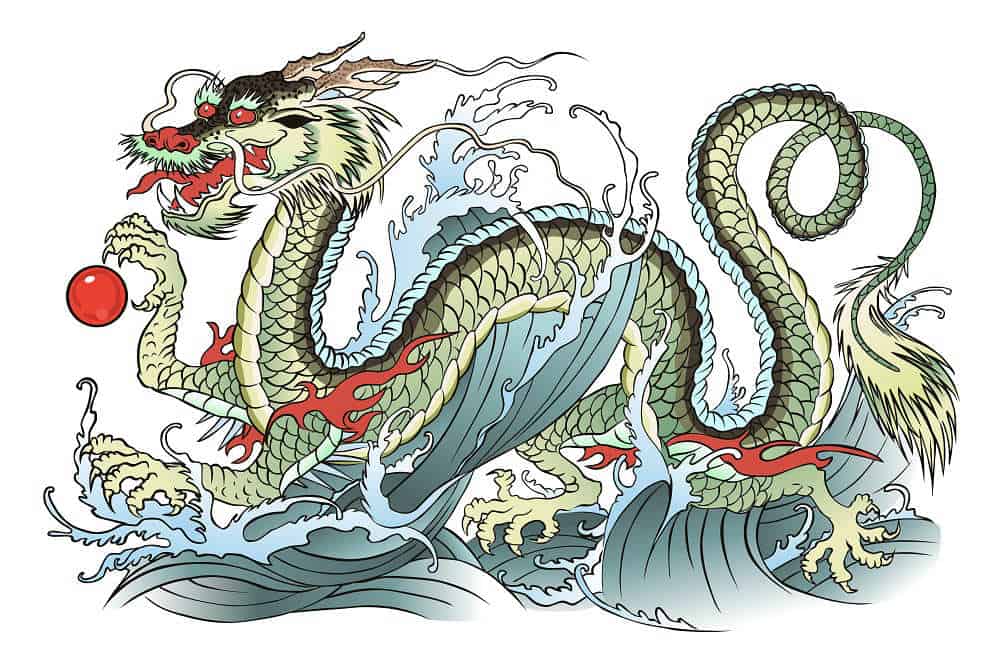
The Pearl of Wisdom
Some Chinese dragons are seen with a flaming pearl under their chin. This pearl represents the “Sacred Pearl” or “Pearl of Wisdom”. The simplest metaphor is ‘truth and life’, a Taoist concept in which the moon, water, pearls and serpents have a complex relationship. It means we should all speak our own truth, and what is true and meaningful for us, may not be for someone else.
Both the moon and the serpent are symbols of immortality in that a snake sheds and is reborn and the moons phase renews every month. The moon has influence over all the earth’s water, including the water in the human body. Despite the strong lunar symbolism and the connection with oceans, tides and water in general, however, there are some myths that also connect the pearl with thunder, the sun, and egg symbolism. All are viable interpretations, and is largely dependent on what the dragon’s purpose is. For example:
- There are dragons carved on the tops of bells and gongs, because of the beast’s habit of calling loudly when attacked.
- A second type is carved on the screws of fiddles, since most dragons are fond of music.
- A third is carved on the tops of stone tablets, because of dragons’ love of literature.
- A fourth is found at the bottom of stone monuments, as dragons can support heavy weights.
- A fifth is placed on the eaves of temples, as dragons are ever alert to danger.
- A sixth occurs on the beams of bridges, since dragons are fond of water.
- A seventh is carved on Buddha’s throne, as dragons like to rest.
- An eighth is placed on the hilts of swords, since dragons are known to be capable of slaughter.
- The ninth is carved on prison gates, as these are dragons that are fond of quarrelling and trouble making.
And on days like this, it’s not too difficult to imagine a lithe and feathered serpent twisting through the stormy air, coiling around the heavy clouds, tail whipping the rain into a sizzling mist, with a roar like distant thunder…
 Dance the Fire