
So, one of my friends posted a whimsical (and mostly rhetorical) question on social media the other day pondering why dragons love treasure so much.
This left me in an unusual position. Do I join in with the silliness and hypothetical suggestions, or geek out and share what I know, potentially looking like at best a killjoy or at worst; a pompous ass. Here’s the compromise – I left a comment saying I knew the connection, and decided to blog my answer over here. So if you followed the link from the thread: welcome! Prepare to be shocked.. Stunned… Or possibly just disappointed at the anti-climax of it all. 😂
TL:DR answer is TREASURE = KNOWLEDGE.
The longer explanation is this: Under scrutiny we have the stereotypical grumpy dragon, wallowing in a cave hoarding a mountain of gold, jewels, armour and sacred objects, offering a fiery death to any Knight or hero who dare enter the lair. How did this come about?
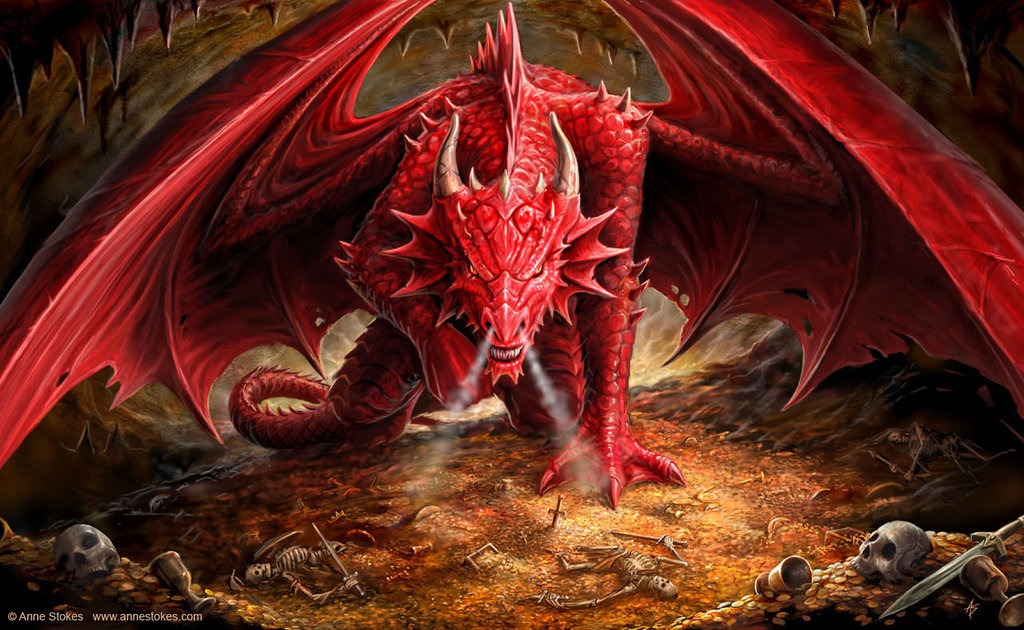
Well, considering in this context that dragons are mythical beasts, then I’m afraid we must recognise that the treasure hoard is also mythical. Or rather, metaphorical and the real historical events behind this fantasy have been smudged and rewritten, devalued and told as only fairytale.
The word ‘Dragon’ as we know it comes from the Greek ‘Drakein’ whose meaning translates as ‘that which sees’ or ‘that which shines’ and relates to the eye. The eye can both see and shine. It can can see to read and learn, and it can shine from the knowledge it has gained. From this, the mantle of Dragon was given to learned people; chiefs, druids, prophets, healers, alchemists and astrologers. Also, strangely mixed up in this bunch were the blacksmiths for they had the knowledge of how to manipulate fire and smelt. (This is why forges are considered magical places.. But that’s a story for another time.)
This knowledge was passed down through oral tradition for millennia and it accumulated like a snowball rolling downhill with every generation, adding to its wealth as technology grew. And this is where knowledge becomes treasure: wealth. What is precious and irreplaceable? How do you place a price on knowledge?
In the days of the early Celtic Church in Europe (4th & 5th century onwards) many ‘dragons’ were invited to have their knowledge written down by the monks. This was not well received as many believed knowledge to be a living thing in itself and so resistance began between Christian scholars and the leaders of the local communities until most people denied knowing anything of worth. What was particularly coveted was the sacred teachings and ancient beliefs held by the Pagan people of the time and the lineage by which they had come by this knowledge.

The ‘dragons’ (mostly druids by this point) refused to give it up. Remember, they considered it a kind of blasphemy to actually write down something that was so sacred. If knowledge was a living thing, then defining it forever on paper would be akin to trapping it and preventing it from growing. It would mean killing it.
So what happened? Unfortunately what happens too often; the demonisation of ‘the other’. As Celtic Christianity gave way to Roman Christianity the pursuit of those still teaching and celebrating the old ways became even more zealous as the new religion sought to convert and thereby control the people. Druids went into hiding. Some were captured and killed. Some were captured and gave in following torture and dictated their sacred histories to monks who Anglicised them bringing them in line with Rome’s version of the one true God of the newly adopted Abrahamic traditions. These Druids were the early ‘saints’, their tortured deaths repackaged as martyrdom.
The imagery of the protective beasts of the (also resistant) Northern European tribes (vikings, basically) was taken and vilified. Instead of the Dragons head protecting the bow of a boat or the gable of a house, they were now depicted snarling over the treasure they refused to give up, not they wealth of generations, but reduced to piles of jewels and gold. Gold and family heirlooms that the tax collectors of Rome had so recently extracted from people whose families had lived and worked this land since the dawn of time (a sad and familiar story).
And there you have it. The demonisation of those with knowledge by those with power, and the vilification of a sacred guardian to act as a cautionary tale to others who resist the authority of the Church.

